




Elizabeth David for Vegans and Vegetarians
Posted on Sun 2nd August, 2026 by Alexander Reid – Guest Writer
In June this year, I wrote an article for Elizabeth David Matters (‘The Search for a Summer Pudding’), which detailed the efforts I had undertaken to secure a magnificently unusual dish for a teetotal near-vegan vegetarian guest (a first as far as my table for happy carnivores was concerned!). I had been convinced the desired forgotten recipe (later revealed to be a tomato summer pudding) was one of Elizabeth David’s and had spent hurried hours tearing through three of her early books to find it, only to later trace it to Jennifer Paterson’s ‘Feast Days’. The process had taken all the longer while consulting her books as a result of vegan and vegetarian recipes not being identified or included in the index.
As it is my desire to train as a professional cook, I have been collecting recipes, articles and cookery books for years. After some research, I realised that of the dozens and dozens of books lining the shelves, only a very few bothered to make the process of locating such recipes any easier. Out of interest, I raised a query with the professional body of the Society of Indexers, and my concern was kindly addressed by one of their members who specialises in cookery books. I was informed that indexers are often restricted by the publisher’s style guide. While their general preference would be to identify recipes with some kind of indicator, consideration of allocated space is often the culprit behind the lack of separate listing of vegan and vegetarian recipes. As the index is the last part of a book to be completed, publishers work out in advance exactly how many pages are available, and they rarely want to add extra paper to give more space for the index, because this has an impact on costs. Indeed, with insufficient space, restrictive selections regarding what can be indexed are required, which can prove extremely frustrating for indexers, especially given the preference publishers, mindful of sales, have for the inclusion of attractive photographs of completed dishes and their books’ authors.
I was grateful for this extensive explanation, even if the irritation remained that cookery books purchased and taking up so much space should create extra work for me by not providing what should have been provided, especially given the frequent excess – and excessive – number of photographs!
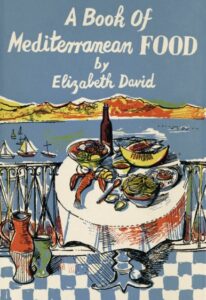
However, I would not fault Elizabeth David in this. There are no photographs in her early works, only illustrations famously provided by John Minton, Renato Guttuso, and Adrian Daintrey. Nonetheless, I felt that for the future it would be wise to write down the recipes I had found in my search. Therefore, I spent several hours writing down the dishes located in ‘A Book of Mediterranean Food’, ‘French Country Cooking’, and ‘Summer Cooking’. Strangely enough, this work, though tiring given the concentration required (there are so many recipes, one has to be eagle-eyed where ingredients are concerned!), proved incredibly rewarding.
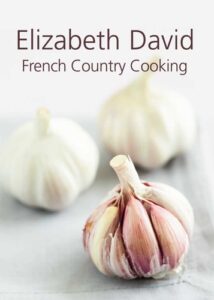
Later, to then complete the process, I took my copies of ‘Italian Food’, ‘French Provincial Cooking’, and ‘Salts, Spices and Aromatics of the English Kitchen’ to the reading room of a south London reference library (it is easier to study when away from home distractions) and spent a happy couple of days noting the various vegan and vegetarian recipes. This proved an instructive as well as interesting activity as you appreciate the vast knowledge of recipes she knew by heart, and also enjoy a better sense of how she structured and wrote her books. A great noticeable difference in her writing is when she reflects on the food from countries outside Britain where she had lived. Memory is very much in evidence when she informs us of the ingredients and preparation of dishes from Greece and Egypt, where she had stayed during the Second World War, and certainly in the case of France, where she had spent part of her youth. Unfortunately, but understandably, given the love of the French for butter, cream and cheese, ‘French Country Cooking’ and ‘French Provincial Cooking’ provide few options for the vegan eater, though there are vegetarian recipes that, with the right substitute, could do just as well.
Though there are a limited number of recipes for vegans in her books on French cookery, the same cannot be said for ‘Summer Cooking’. Though lighter in tone than her other published works, her fourth book, with its abundance of vegan and vegetarian dishes, leads with the message that even in the age of tins and the deep freeze, nothing can be better than eating good food made from fresh ingredients picked from the tree and the earth at the right time of year. Though few of us would return to the days before modern convenience, even fewer would object to her argument that when it comes to the taste of vegetables and fruit in season, some things are very much worth the wait.
While ‘French Provincial Cooking’ is considered by many to be her masterpiece, it was the publication of ‘Italian Food’ in 1954 that cemented her reputation as one of Britain’s premier food writers. Not having lived in Italy in her younger days, she was able to write about Italian dishes without nostalgia or sentiment, and, therefore, developed the critical eye that would be integral to her later journalism and scholarship. She correctly identified the fundamental importance of regionalism in Italian society. After la famiglia and la mamma, Italians’ greater loyalty is arguably to their hometown or region rather than to the country itself, and Elizabeth David understood this well as she watched i fiorentini, i romani e i napoletani at work preparing the dishes of their own cities. ‘Italian Food’ offers the vegan eater a number of fine salads as well as such simple wonders as mushrooms stewed in vine leaves. And of course, as you will see, the cheese-eating vegetarian is in for an even greater treat!
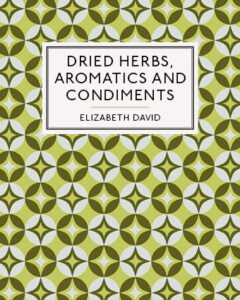
Those who don’t eat meat or fish are also not shortchanged in her later works. ‘Spices, Salt and Aromatics in the English Kitchen’, published in 1970, revealed the great depth of her reading and study. In the introduction, she informs the reader of the books she had turned to while recovering from an illness in the early sixties. She had clearly read widely, and her readers benefit greatly from her gained knowledge and expertise, not to mention her unquestionable sense of history. Additionally, we see her turning back to the dishes of her country, her sights having been previously been very much set across and beyond the Channel. British dishes were included, almost grudgingly, in ‘Summer Cooking’, but it was with the publication of her sixth work that she truly returned to the English kitchen. With wonderful yet simple dishes and advice for producing sauces, chutneys and pickles, ‘Spices, Salt and Aromatics’ is very much a book to cook from, and its author challenges the reader to think of the act of cooking and the dishes such effort produces in a different way.
Indeed, Elizabeth David never stopped challenging the British eater, through her books and her journalism, and that is something for which we can be grateful. The great fight went back to 1947, the year she had fought to keep soul and spirit alive against the twin evils of post-war rationing and awful weather by turning to memory and putting pen to paper. ‘A Book of Mediterranean Food’, the result of this battle, was published three years later. Her first book was very much not a mere collection of recipes: it was, in fact, a culinary call to arms, an open rebellion against food that was boiled, bland and, frankly, bad.
Few, if any, would deny that the world of today is far removed from the one of 1950, not least in its inhabitants’ eating habits. And yet, despite changes in attitudes, the wealth of meals suitable for vegans and vegetarians, and the greater accommodation of their needs in the present day, it should be noted that less than eighty years ago, for millions of Britons, there were included in the pages of her book fruit and vegetables completely unknown and dishes practically unthinkable, a fact it would be advisable not to take for granted today.
Alexander Reid – Guest Writer
Despite working for many years in various administrative roles, Alexander’s career ambition is to become a professional cook.
Although aware of Elizabeth David’s reputation, Alexander only started reading Elizabeth David’s books some six years ago and hasn’t thought of food the same way ever since. In addition to collecting her vegetarian and vegan recipes, as they are not identified as such in her books, Alexander is also conducting a review of Elizabeth David’s early journalism.
