



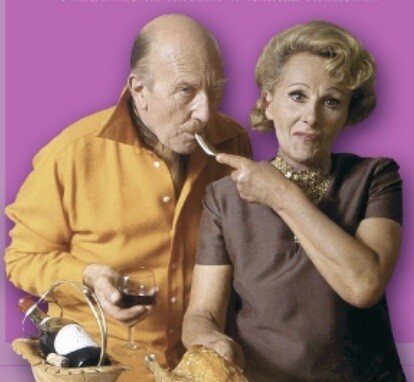
The day Elizabeth David hid from Fanny Cradock!
Posted on Sat 22nd August, 2026 by Alexander Reid – Guest Writer
In November 1965, a new shop opened in Pimlico. A retailer of kitchenware bearing the name of Elizabeth David Ltd. Given its famous namesake, the shop immediately attracted attention. As well as curious shoppers, it drew in the rich and famous, including none other than the Queen’s sister. Staff watched in awe as Princess Margaret, for whom the kitchen was not a natural habitat, inspected the items on display while smoking a cigarette from a long holder. Having reduced her journalistic commitments, Elizabeth David would spend her days in the shop, ready to welcome such prolific guests as well as customers willing to take her advice and purchase accordingly.
There was one arrival, however, who proved most unwelcome. So much so that the great woman simply turned and hid. The visitor in question was Fanny Cradock.
Accompanied by Johnnie Cradock, her partner (though believed to be her husband, they would not marry until years later), the famous television cook arrived to see the shop that such a fuss had been made of in recent weeks. They had even sent a good luck telegram to Elizabeth David on its opening. According to a business associate, when interviewed for one of her biographies, Elizabeth David simply ‘couldn’t stand them’.
She was not alone in her aversion. Despite their tremendous popularity, many didn’t care for the Cradocks, and for Fanny Cradock in particular. She was an acquired taste, and like Elizabeth David, was known for her exacting standards and work ethic, not to mention fierce personality. For all their differences, they were human industries working to educate people on their possibilities of food in a very different world from that of their parents. Elizabeth David prepared her own meals while her mother had enjoyed the services of a cook, a reality for many in the post-war age with increased costs and the decline of domestic service. A great part of Fanny Cradock’s appeal to viewers facing this dilemma was the preparation of grand, flamboyant dishes, her opinion being that the eye had to be fed before the body, a view definitely not shared by Elizabeth David.
Despite their influence on the public, both women could not be described as rivals. Fanny Cradock’s realm was the television and the stage, while Elizabeth David’s was in her books and articles, and, for a time, the shop. Elizabeth David shunned publicity while Fanny Cradock revelled in it. While Fanny Cradock co-wrote the ‘Bon Viveur’ column with Johnnie Cradock for ‘The Daily Telegraph’ (Elizabeth David would also later write for the newspaper) and produced dozens of books on food, it would be unwise to compare or even discuss them in relation to the works of Elizabeth David. There is a reason the eight books Elizabeth David wrote in her lifetime remain celebrated and in print today, while Fanny Cradock’s output was forgotten as soon as published.
The visit was a decade after they were firmly established in their respective fields, with 1956 being a year of particular professional triumph. With new contracts to write for prestigious publications like ‘Vogue’ and ‘The Sunday Times’, Elizabeth David was now the nation’s leading food writer. Fanny Cradock’s stardom was confirmed when thousands of people flocked to the Royal Albert Hall to watch her and Johnnie Cradock in formal eveningwear preparing onstage an Escoffier-inspired feast including onion soup with port wine, roast turkey and Pêche Melba. One of the memorable moments was Fanny Cradock opening a shaken bottle of champagne buried in a mountain of sauerkraut to great applause from her audience. The show proved a success, and the following year, at the Ideal Home Exhibition, her draw was made plain by the Queen and the Duke of Edinburgh extending their time with the Cradocks instead of moving on to view the other exhibits. Fanny Cradock gave the monarch’s husband a tour of her mock kitchen, even causing him great amusement with his discovery of behind-the-scenes messiness.
The fifties were good to Elizabeth David and Fanny Cradock, as were the sixties, though Elizabeth David battled with health and personal problems before opening the shop. The seventies would also have their challenges. Severing her ties with the enterprise after a fallout with the shop’s partners, a few years later Elizabeth David would make her comeback. In 1976 she received an OBE and the following year saw the publication of the influential ‘English Bread and the Yeast Cookery’, which would sell thousands of copies and earn its author the Glenfiddich Award.
Her renewed success coincided with the decline of Fanny Cradock, who, after two decades at the top, would experience a marked reversal of fortune. Indeed, in November 1976, her career would effectively end overnight.
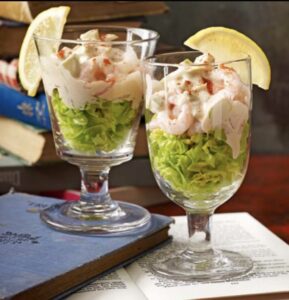
Gwen Troake, a housewife from Devon, after winning the ‘Cook of the Realm’ competition, was to see her award-winning menu served at a banquet for dignitaries at London’s Dorchester Hotel. In advance of the grand affair, Gwen Troake would receive advice from experts, including the likes of actor and gourmet Robert Morley and Fanny Cradock. Viewers of Esther Rantzen’s ‘The Big Time’ expecting light, easy-going entertainment were treated to something entirely different. Fanny Cradock’s appearance proved to be one of the earliest examples of car crash television. Over the course of a few minutes, Fanny Cradock disregarded Gwen Troake’s menu of seafood cocktail, duckling with bramble sauce and coffee cream dessert, pulled faces at the camera and even mocked the food and her own company. ‘These are all so English,’ she cried in disgust, later adding, ‘The English have never had a cuisine. There’s nothing English! Yorkshire pudding came from Burgundy’. Under attack from an expert, amateur Gwen Troake appeared at times almost tearful, and was persuaded to change her chosen dessert to fruit sorbet in small pastry boats, a decision which proved disastrous, as the spun sugar toppings would fade in the heat of the Dorchester kitchen.
The public’s reaction was swift and unforgiving. Along with jumping a queue, little draws the wrath of the British more than bad manners and a lack of fair play, and Fanny Cradock’s treatment of Gwen Troake had both combined. She never cooked on television again, and Delia Smith took her place as the BBC’s Queen of Cooking.
Elizabeth David and Fanny Cradock would die within a few years of each other, in 1992 and 1994 respectively, though with very different reactions. In addition to a VIP-heavy memorial service at St Martin-in-the-Fields and a memorial picnic at the Institute of Contemporary Arts, there was great attention when Elizabeth David’s possessions were sold at auction, with Prue Leith (now of ‘Great British Bake Off’ fame) paying over a thousand pounds for the kitchen table at which Elizabeth David had written and cooked at her home in Halsey Street. On the other hand, despite her great fame, Fanny Cradock’s death in a nursing home a few years later was met with little fanfare.
In 2006, two dramas on the two women appeared on the BBC: ‘Elizabeth David: A Life in Recipes’ and ‘Fear of Fanny’. The latter is available to watch online and was even rebroadcast last year, while the former is not to be found, save for a few clips. Both show their respective subjects at the height of their professional powers, with a focus on their personal problems, including the breakup of Elizabeth David’s affair with Peter Higgins and Fanny Cradock’s dysfunctional relationship with her son Christopher.
Interestingly, in separate scenes, the women discuss their philosophy of food:
Fanny Cradock, played by Julia Davis, reflects on food in Britain before she came on the scene.
‘Wizened lamb chops and greying mashed potato. Bog-standard postwar fare. That’s what one saw dolloped out daily.’ She then, without a shred of irony, calls this time, ‘BFC – Before Fanny Cradock’.
In ‘A Life in Recipes’, Catherine McCormack’s Elizabeth David counters with what could be seen as an attack on the extravagant dishes Fanny Cradock prepared on television.
‘The presentation of all food is an important point. Cold food should certainly have a lavish and colourful appearance, but to varnish it with gummy gelatine or smother it with whirls of mayonnaise seems to me a misconception of what makes for an appetising appearance. The effect needed is not of food tormented into idiotic shapes, but of fresh ingredients, freshly cooked and not overhandled.’
She finishes with a cutting swipe to the lover of vegetable dyes and the piping bag: ‘You are, after all, preparing a meal, not decorating the village hall.’
Anyone seeing some of Fanny Cradock’s more exaggerated creations (Oeufs à la Riga being a notable example) would be justified in thinking so. And yet, as easy as it is to disregard Fanny Cradock today, the fact is, along with Elizabeth David, arguably no other Briton did more to transform attitudes to food in these islands in the second half of the twentieth century, and while both women went about doing it in very different ways, that was no bad thing.
Alexander Reid – Guest Writer
Despite working for many years in various administrative roles, Alexander’s career ambition is to become a professional cook.
Although aware of Elizabeth David’s reputation, Alexander only started reading Elizabeth David’s books some six years ago and hasn’t thought of food the same way ever since. In addition to collecting her vegetarian and vegan recipes, as they are not identified as such in her books, Alexander is also conducting a review of Elizabeth David’s early journalism.
