



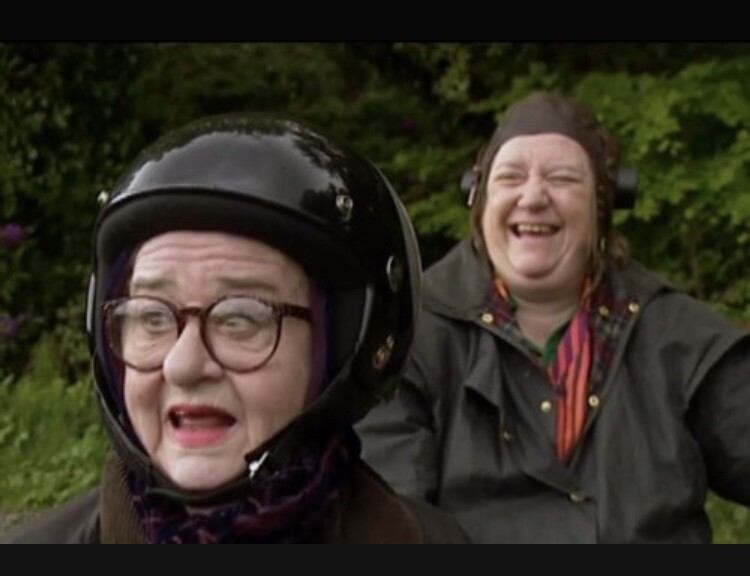
Elizabeth David and the ‘Two Fat Ladies’
Posted on Mon 27th July, 2026 by Alexander Reid – Guest Writer
In April 2013, a few days after it played host to the ceremonial funeral for Margaret Thatcher, St Paul’s Cathedral held an event as part of its ‘Mind of the Maker’ series, in which public figures discussed faith and creativity. One of those interviewed was the cook and writer Clarissa Dickson Wright, who had achieved great fame in the 1990s with the television programme ‘Two Fat Ladies’. In addition to discussing the ups and downs in her life, including her struggle with alcoholism, Clarissa Dickson Wright treated her audience to a story of one of her more interesting encounters while working at the Notting Hill bookshop ‘Books for Cooks’:
“The telephone rang, and I picked it up. It was Elizabeth David! Now I’m of that generation… and I dropped the telephone, and I got it again and picked it up. And she said, ‘Are you all right?’ I mean, I didn’t know her. And I said, ‘Well, it’s rather like, for someone of my generation, it’s… picking up the telephone, and it was God’. I remember saying this to her. And so after that she used to ring me up and say, ‘God calling!’.”
In her memoir ‘Spilling the Beans’ and ‘A History of English Food’, Clarissa Dickson Wright wrote about the brief time she knew Elizabeth David, who was then in the last years of her life. In the latter, she reflects on attending the memorial service at St Martin-in-the-Fields, noting a tribute from an actor who had appeared on stage with Elizabeth David decades before at Regent’s Park Open Air Theatre:
“He described how it had rained so heavily that day that they had been unable to perform, so they’d gone back to Elizabeth David’s flat where she had made him the best omelette that he had ever eaten. His words moved me to tears.”
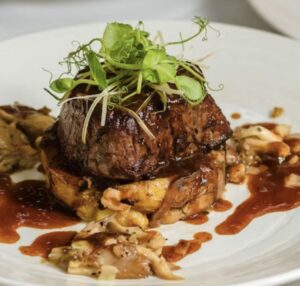
According to press reports at the time, there was another attendee at the memorial, someone who in a few years’ time would share Clarissa Dickson Wright’s television success: writer Jennifer Paterson. Jennifer Paterson, who had been contributing recipes to ‘The Spectator’ in her column since the mid-eighties (she had also previously served as the magazine’s cook for VIP lunches before being famously sacked after throwing dirty crockery out of the top-floor kitchen window in a fit of anger), was without embarrassment in admitting her debt to Elizabeth David. Indeed, in the introduction to ‘Feast Days’, a collection of her columns from 1984 to 1990, Jennifer Paterson wrote:
“The advent of the glorious Dame Elizabeth David’s books was my expedition into proper cooking as for so many others of my generation and all the following ones. She was my teacher and I have never ceased to be grateful to her.”
David never achieved a damehood, however deserved, though other honours, such as an OBE and CBE, came her way, but it was in her influence on others through her writing that she truly triumphed. As Jennifer Paterson believed:
“The pleasure of mastering one of her more complicated dishes to the acclaim of the recipients and oneself was, and is, an immense joy.”
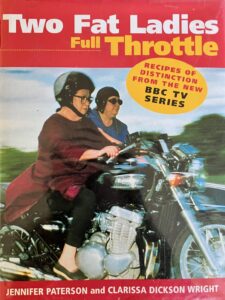
Within a few years of both women attending Elizabeth David’s memorial service, they would achieve fame with ‘Two Fat Ladies’. The autumn of 2026 marks the thirtieth anniversary of the programme’s first episode, which was a jaunt to Cornwall’s Mevagissey where the presenters enchanted viewers with their idiosyncratic banter while preparing fish pie, scallops with leeks and a gigot of monkfish. The series was an instant success, and with the second series, both cooks were established household names. In less than thirty episodes, those tuning in were treated to wonderful dishes such as Portuguese cod cakes at the Brazilian ambassador’s residence, clam chowder at a Cumbria motorcycle rally and jerked suckling pig for Christmas in Jamaica.
While an indisputable hit at home, ‘Two Fat Ladies’ broke ground by becoming the first British cookery show to truly crack the lucrative American market, a territory that had not been open to television stars such as Fanny Cradock or Delia Smith. (It should be noted that the successful programmes of British-born Graham Kerr were produced in New Zealand, Australia and Canada.) Along with models like Kate Moss and Naomi Campbell, award-winning actresses like Emma Thompson and Kate Winslet, and music groups like ‘All Saints’ and the ‘Spice Girls’, Jennifer Paterson and Clarissa Dickson Wright would join the ranks of British women achieving truly global recognition in the 1990s.
Sadly, the series would not last long, as it ended with the passing of Paterson in 1999. Its short three-year existence (four series and less than thirty episodes) coincided with a time of great political and institutional changes for Britain (a new government, the Hong Kong handover, and devolution in Scotland and Wales, to name a few), which made the presenters’ eccentric traditionalism (a blend of the politically incorrect with unashamed social conservatism) all the more appealing for many viewers.
It is worth noting Elizabeth David’s influence on both women, as they not only praised her to the skies but their skills as cooks (and even many of the dishes produced in their books and the programme) had evidently been informed and developed as a result of reading her works. Commenting on her wonderful descriptions of dining in France in ‘French Provincial Cooking’, Clarissa Dickson Wright would argue: “Is it any wonder that my generation rushed off looking for this kind of life?”
In June 1992, in her column for the new magazine ‘The Oldie’, Jennifer Paterson reflected on the passing of her idol:
“What a sad end to a glorious May – the death of the great and illustrious Elizabeth David. I owe her an enormous debt of gratitude, as I’m sure many of us oldies do, not to mention future generations who will be inspired by her books forever, I hope. Her descriptions of cooking and eating should be a joy for any beginner.”
Before moving on to provide a review of a restaurant in Wilton Street and a recipe for jellied rabbit, Jennifer Paterson concluded her tribute to Elizabeth David with “God rest her soul and supply her with endless heavenly delights”. Given her magnificent contribution to food writing and influence on changing attitudes to food and wine in Britain, only a very mean critic could have wished her otherwise.
Alexander Reid – Guest Writer
Despite working for many years in various administrative roles, Alexander’s career ambition is to become a professional cook.
Although aware of Elizabeth David’s reputation, Alexander only started reading Elizabeth David’s books some six years ago and hasn’t thought of food the same way ever since. In addition to collecting her vegetarian and vegan recipes, as they are not identified as such in her books, Alexander is also conducting a review of Elizabeth David’s early journalism.
