



Elizabeth David in España
Posted on Fri 25th September, 2026 by Alexander Reid – Guest Writer
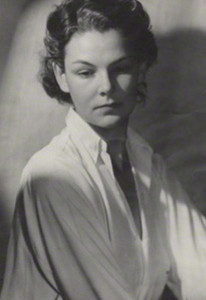
There are good years and bad years, and then there are those in which lives change irreversibly, for better or worse. 1963 was such a year for Elizabeth David. Overworked with journalistic commissions and mourning the end of her affair with Peter Higgins, her health declined, eventually leading to a reported stroke and ending up in hospital. Putting her convalescence to good use, as she later reported in the introduction to ‘Spices, Salt and Aromatics in the English Kitchen’, she devoted the time to reading and rereading the works of cooks and writers who informed her own approach to food and cooking.
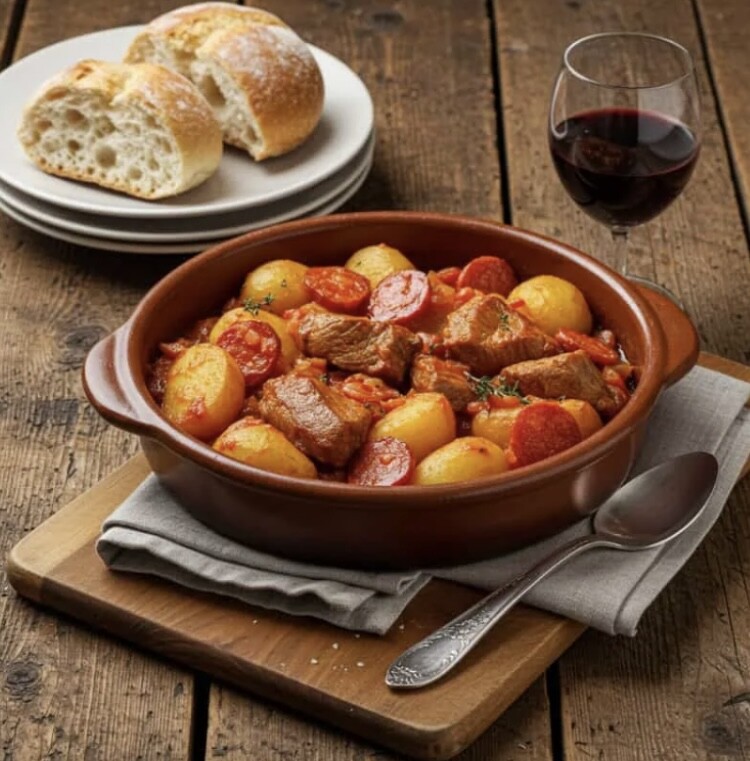
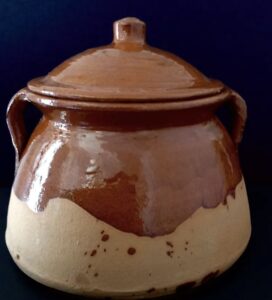
Aware of her illness and need to rest, her friend, the Condé Nast photographer Anthony Denney, invited her to stay at La Alfarella, the small estate he had purchased in the Valencian countryside. According to Artemis Cooper’s ‘Writing at the Kitchen Table’, the visit – Elizabeth David’s first to Spain – was a great success. Not only could she relax but also enjoy the food which was ‘usually prepared in earthenware dishes, heated directly over the Butagaz or on the hearth. It was served on the veranda whenever possible, and eaten overlooking a magnificent view of the mountains’. Returning to England, much revived, Elizabeth David thanked Anthony Denney, describing her time in Spain as a ‘door to new and marvellous things… which only you have shown me, and I feel my life is quite changed, and none too soon, either’.
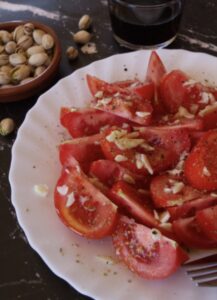
Not only did Elizabeth David’s visit to Spain improve her health and wellbeing, but her second trip also led to one of her finest pieces of journalism, later published in ‘The spectator’ in November 1964. Readers at home learned of the ‘enormous ridged tomatoes’ that formed part of the local salad, which were ‘cored with a little sharp knife, cut roughly into sections, thrown into a shallow bowl, mixed with thickly sliced raw onions, mild and very sweet. Salt, a sprinkling of olive oil and wine vinegar were only seasonings… It had no regional picturesque name. It is just ensalada.’
The article was entitled ‘Para Navidad’ (meaning ‘For Christmas’). According to Artemis Cooper, the article’s title ‘refers to the way everyone in that part of Spain was making delicious things and storing them up for Christmas: the piece is imbued with the excitement of something to work towards and look forward to’. ‘Para Navidad’ is worth noting on several fronts. It was a Spain unknown to many, and far removed from the package holiday that within a few years transformed how many Britons chose to spend their time in the sun. It offers not only beautiful descriptions of rural Spanish village life, the surrounding lemon-growing countryside, and the food Elizabeth David enjoyed during her visit, but also one of the final examples of the type of writing for which she had became famous. It is a last gasp of the nostalgia and lyricism that had attracted readers to her early works before she moved towards the research and scholarship that defined her later career.
Spanish recipes appear from time to time in her books, though they are very much in the minority compared with the dishes of France, Italy, Greece and the Levant. ‘A Book of Mediterranean Food’ provides wonderful recipes for gaspacho, paella and quince paste. Elizabeth David even furnished her description of gaspacho by quoting from Théophile Gautier. In his 1843 travelogue, ‘Voyage en Espagne’, the 19th-century French Romantic writer and critic made clear he was not an admirer of the cold soup, even writing it off as a ‘hell broth’.
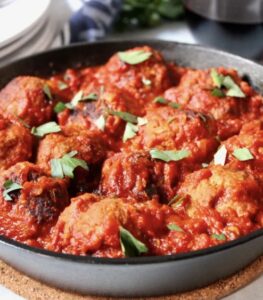
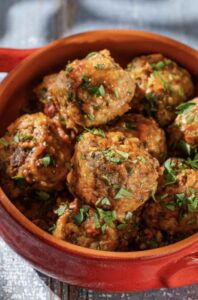
‘Para Navidad’ goes further than any of her previous reflections on Spanish food, and though published over half a century ago, the writing remains fresh and timeless. We see Elizabeth David describe the dish of albóndigas prepared by her host, ‘little rissoles fried in olive oil. He fries them skilfully and they merge with a caramel-brown and gold coating reflecting the glaze of the shallow earthenware sartén, the frying dish in which they have been cooked and brought to the table’. She notes the earthenware pots used for cooking and the metal pans for large paella and frying tortillas; enjoys meals of red mullet and grilled sardines a la plancha; and praises the ‘delicate and fine-grained pork meat, and the cured fillet, lomo de cerdo, is by any standard a luxury worth paying for’. Elizabeth David also benefitted from the knowledge shared by the local women who worked for Anthony Denney. Juanita, for example, asked for empty wine bottles for preserving tomatoes for winter, which were then sliced, packed in bottled and sealed with olive oil. The article’s title resulted from Juanita’s method of preparing tortilla was also later included in ‘Is There a Nutmeg in the House?.)
Elizabeth David ends the article on receiving a gift of saffron to take home to England, along with the joy of a fiesta day in the local village following the advent of rain. Anyone reading the article in the mid-sixties could well see the potential for a book in the future on Spanish food, given how well she wrote of the country, though that, alas, was not to be.
A year later, Elizabeth David’s kitchenware shop in Bourne Street was opened to great fanfare, and all of her energy was preoccupied. By the time she started writing books again, it was the food of Britain, not that of the Mediterranean, to which she turned her attention. Spanish cuisine, therefore, has no equivalent to ‘Italian Food’ and ‘French Provincial Cooking’ in the Elizabeth David canon. While recent years have produced credible candidates, there remains no definitive text or authority that British readers turn to for inspiration, which therefore leaves many people’s knowledge of the food of the land of Cervantes, Lorca and Picasso (save for the more famous dishes) as limited as their grasp of the language (‘¡Hola!‘, ‘¿Qué tal?’ and ‘Dos cervezas, por favor’ being the well-known exceptions).
Reading ‘Para Navidad’ again all these years later, it is clear what wonders Elizabeth David could have made of Spain, a country she described visiting as the ‘door to new and marvellous things’, had her energies not been diverted elsewhere, and though we have a few of her writings on Spanish food and drink here and there, the resulting lack of such a book is, indeed, no small loss.
Alexander Reid – Guest Writer
Despite working for many years in various administrative roles, Alexander’s career ambition is to become a professional cook.
Although aware of Elizabeth David’s reputation, Alexander only started reading Elizabeth David’s books some six years ago and hasn’t thought of food the same way ever since. In addition to collecting her vegetarian and vegan recipes, as they are not identified as such in her books, Alexander is also conducting a review of Elizabeth David’s early journalism.
