



California Calling
Posted on Sat 10th October, 2026 by Alexander Reid – Guest Writer
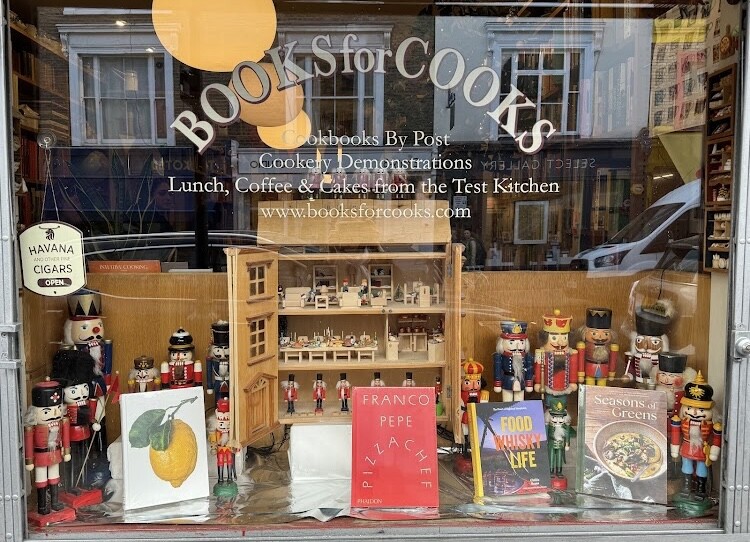
Nearly forty years ago, a woman living in a halfway house started working in a cookery book shop in Notting Hill. Not long sober and recovering from a decade in which she had faced alcoholism, bereavement, professional failure and financial ruin, the former barrister and cook-housekeeper channelled her time and energy into making Books for Cooks a success. The efforts of Clarissa Dickson Wright (later of ‘Two Fat Ladies’ television fame) soon paid off, as the shop proved popular with the buying public, achieved recognition at home and abroad by being included in Delia Smith’s 1990 Christmas special and profiled in the ‘New York Times’ in 1992, and also attracted the crème de la crème of international food-writing. As she later noted in her bestselling 2007 autobiography ‘Spilling the Beans’:
“Books for Cooks flourished and became like a club for food writers: everyone came: Adrian Gill sat on a stool beside me and talked about Brown Windsor, my heroes Anna Del Conte and Sri Owen came often to discuss books. One day the phone rang and when I answered it it was Elizabeth David. I was so stunned I dropped the phone. When Elizabeth asked me what was wrong I said for someone of my generation it was rather like answering the phone to God. She thought this very funny and when she rang in future would say, ‘God calling.’”
Before her sacking after a fallout with the shop’s owner and relocation to the east coast of Scotland, Dickson Wright, as she read through the vast stock of titles between sales, was well-placed to observe that times had changed in the world of food and drink.
“In the late 1970s and early 1980s five American chefs, Alice [Waters], Jeremiah Tower, Deborah Madison, Wolfgang Puck and Mark Miller with his Mexican fusion, had changed the face of cooking by inventing New Wave American Cuisine. Before this each country’s cooking followed its own instrumental equations: for instance the French put peas or orange with duck, the Moroccans used specific spices in specific tagines and never varied, we served horseradish with beef and mint with lamb – you get the idea. The American five burst this whole pattern wide open to some amazing combinations and techniques, and when it worked it was fantastic but when it didn’t you’d be using mouthwash for a week. This is the fusion that was taken up by Australia and changed into Pacific Rim fusion but it also affected Britain in its own right.”
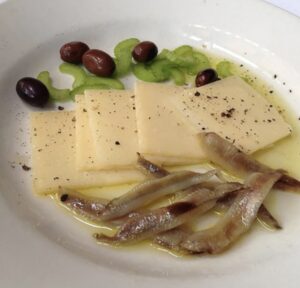
It was a time of growing public interest in food and restaurants, with the eighties being the decade when California truly emerged as a player in international cuisine. Having long been considered inferior by its New York counterparts, its cooks were now hitting back, opening fine restaurants and producing one innovative dish after another. Health-conscious Los Angeles, a city mocked in the movie ‘Annie Hall’ as a place to eat a “plate of mashed yeast”, saw the Hollywood elite being enchanted with the house-smoked salmon pizza with caviar and crème fraîche created by Austrian chef Wolfgang Puck at his new restaurant Spago. (Its last-minute invention is rumoured to be the result of actress Joan Collins ordering smoked salmon with brioche on a day the restaurant ran out of bread!) His colleagues Mark Peel and Nancy Silverton later co-founded the famous Campanile restaurant and La Brea Bakery, the latter making freshly baked artisan bread a hot ticket among LA foodies, selling like hot cakes. (Silverton’s contribution to American breadmaking was memorably covered in an episode of Netflix’s ‘Chef’s Table’.) In Berkley, Alice Waters’ Chez Panisse, open since 1971, became the champion of the farm-to-table movement, serving dishes made from the freshest ingredients in season to its patrons. The great city of San Francisco was also no stranger to the culinary revolution, as David had already noted on her travels.
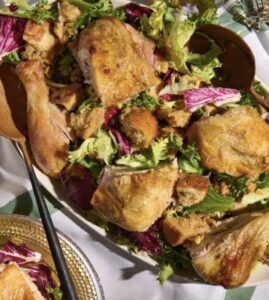
In addition to the publication of the celebrated ‘An Omelette and a Glass of Wine’, her at times spiky articles for ‘Tatler’ (‘Scoff Gaffe’, her takedown of ‘The Official Foodie Handbook’, being particularly memorable) and academic pieces for ‘Petits Propos Culinaires’, the last decade of her life also saw long annual trips out of Britain to the so-called City of Fog. She stayed at the home of Gerald Asher, former wine merchant and wine editor at ‘Gourmet’ magazine, which enjoyed wonderful views overlooking the Bay and the Golden Gate Bridge. Artemis Cooper’s ‘Writing at the Kitchen Table’ tells us that within hours of arriving at Asher’s apartment, her bedroom “looked exactly like her own in Halsey Street. On a tray were her pens and scissors, plus the little wooden-handled Opinel knife that she never travelled without. The rest of the bed soon vanished under piles of books, newspapers and magazines, marked with little yellow stickers, with her annotations and exclamations carefully written out in green ink. Beside the bed was a thermos of black coffee and a cup, at which she sipped occasionally. More black coffee arrived early in the morning, with toast and tropical fruits. The room she was given was ample and comfortable. It looked east; and on clear days, sunlight streamed in all morning.”
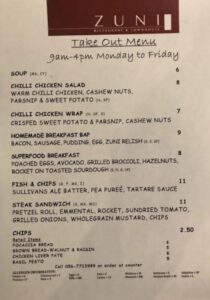
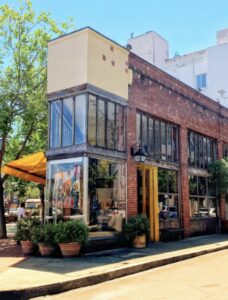
She was a much-sought-after guest among the local cognoscenti, and the legacy of her time in San Francisco remains very much in evidence today. On one visit, while wandering about the city, she came across a man called Billy West illegally cooking food on a grill on wheels in an alleyway. The fare was modest but delicious, and her later endorsement helped it succeed in the city’s food scene. Zuni Café, still very much in operation, continues to acknowledge its debt to its British patron, currently noting on its website that its “earliest menus were inspired by the cookbooks of Billy’s culinary idols, Diana Kennedy and Elizabeth David; but they were limited by a kitchen that consisted of little more than a toaster oven, an espresso machine that doubled as an egg-cooker, and a kettle grill in the back alley. Nevertheless, the restaurant was an instant, improbable success; Elizabeth David herself became a repeat customer”.
Declining health brought a halt to her stateside expeditions, which soon proved the beginning of the end. On her death in 1992, Asher wrote an appreciation of his late friend in the ‘Los Angeles Times’. Readers learn that while David didn’t particularly care for the state’s “home-grown cheeses, she enjoyed California wines and took a great interest in the young restaurateurs among whom she had long been a cult figure”. She also took great interest in the “enormous choice of fruits and vegetables we have on the West Coast. I remember how amused she was once when we had driven down the coast to lunch at Pescadero, a fishing village between Half Moon Bay and Santa Cruz. It was November, very bright but chilly, and we ordered the hot pumpkin soup of the day. Knowing that the farms around Half Moon Bay were well known for their pumpkins (there is a Pumpkin Festival there every year), she was curious to find out what variety of pumpkin would have been used for the soup. The waitress had no difficulty telling her. ‘Oh, that was our Halloween pumpkin,’ she said brightly and whisked busily away.”
No longer called to the Mediterranean, California provided a home from home in her final years, and decades later, the chefs of the Golden State continue to dazzle the world with dishes that blend the modern with tradition while surpassing the art of the possible in cookery, something of which David would surely (or hopefully!) approve.
Alexander Reid – Guest Writer
Despite working for many years in various administrative roles, Alexander’s career ambition is to become a professional cook.
Although aware of Elizabeth David’s reputation, Alexander only started reading Elizabeth David’s books some six years ago and hasn’t thought of food the same way ever since. In addition to collecting her vegetarian and vegan recipes, as they are not identified as such in her books, Alexander is also conducting a review of Elizabeth David’s early journalism.
