


Elizabeth David and Restaurants
Posted on Sat 7th November, 2026 by Alexander Reid – Guest Writer
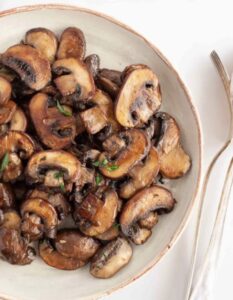
A chef in a smart restaurant was informed that one of his guests was none other than Elizabeth David. Leaving the kitchen to pay his respects to the writer of classics such as ‘A Book of Mediterranean Food’ and ‘French Provincial Cooking’, he expected praise for his dishes, but the poor man would be proved wrong. Not one to mince her words, she instead took him to task for a menu boasting of ‘wild’ mushrooms when, in fact, what was on the plate before her proved to be anything but!
There are plenty of such anecdotes from restaurants she visited, both at home and abroad. Indeed, even her friend, the novelist Sybille Bedford, who often dined with her in London establishments, was taken aback by her at-times imperious behaviour at table. Restaurateur Prue Leith, in pre-‘Bake Off’ days, while believing David to be the ‘best food writer in the country’, found her tricky in company, adding she could be ‘unkind about other writers and cooks and I wondered whether she slagged me off too when I was out of the room’. Fellow chef and television presenter Keith Floyd, despite being very much in awe, remembered only too well the lady’s more than cutting reply to the waiter with the pepper mill who asked if he could ‘grind’ her!
While shivering at her froideur (even if directed at someone else), to Floyd, whose own restaurants sadly ended in financial failure and closure (due in part to his reported generosity and lack of business sense), she could do no wrong, remaining his ‘all-time hero’. Believing she deserved a damehood, the star of such hit programmes as ‘Floyd on Fish’ and ‘Floyd in France’ recalled fondly in his autobiography ‘Stirred But Not Shaken’ that the ‘first thing I ever cooked that I was proud of was her chicken, gently roasted in oodles of butter.’ Jeremy Lee at Quo Vadis, the Soho restaurant and members’ club, remembered fondly cooking for her early in his career. At Bibendum, the author of his mother in Scotland’s much-consulted copy of ‘Spices, Salt and Aromatics in the English Kitchen’ would ‘come up in the goods lift (in the latter part of her life she needed assistance). I was terribly young and gauche. Once, when her wheelchair trundled past the pastry section, I was putting away a lemon tart, and she said: “Oh, save a slice for me.” Simon Hopkinson, who was chef-patron and her friend, came in afterwards and said that she liked it very much. That’s the nearest I got, but then, I sometimes think you shouldn’t meet your heroes. I’ll always have this idea of what she was and know her through her writing.’

Restaurants had played a part in David’s first taste of independence as a young woman. In ‘French Provincial Cooking’, David remembered boarding with a food-obsessed family in Paris while studying at the Sorbonne in the early thirties. Deception often proved necessary as she enjoyed simple dishes like egg mayonnaise and petits pois in establishments that did not meet her hostess’s approval. She would memorise the menus of approved restaurants, but her efforts often failed to convince as she was hit with question after question by Madame: ‘What appalling ordures had been in the so-called vol-au-vent? Were the boulettes de viande made from beef or veal or lamb? Ah, tiens, des épinards à la crème, and did they really contain cream or some horrible sauce blanche? Vous ne le savez pas? Mais comment, chère Elisabeth, you did not notice?’ Decades later, no longer bound by politeness and from the safety of London, came the reply: ‘No, chère Elisabeth had not noticed and did not care…’.
But the French lady’s culinary interrogations likely contributed to her English boarder’s later directness when it came to food. Across the Channel, in a land where disapproval is often revealed by pursed-lip dignity, polite passive aggression or bitingly laced language (a unique blend of which Britons can be proud!), David was not one to hold back when she felt standards of cooking and service were slipping, and particularly when she was the one to suffer from such lapses. And hold back she didn’t!
Writing in the summer of 1962, the year before the world saw the publication of Betty Friedan’s groundbreaking ‘The Feminine Mystique’, David, with dry amusement rather than feminist anger, penned a short piece on attitudes to female patrons eating alone or without the company of a man prevalent in male-run establishments. At a mere ‘blink-or-you’ll-miss-it’ two hundred or so words, in ‘Ladies’ Halves’, later included in ‘An Omelette and a Glass of Wine’, David asks the question: ‘What on earth comes over wine waiters when they take the orders of a woman entertaining another woman in a restaurant?’ ‘Spectator’ readers were informed of the common problem of her being kept waiting for at least twenty minutes after placing her order for a bottle, only for a half-bottle (barely enough for one person, frankly, let alone two!) to be brought to the table. While acknowledging half-bottles possessed a ‘special charm of their own’, she politely cursed the wine waiters who deliberately disregarded her instructions, assuming they regarded women being ‘too frail to consume or too stingy to pay for a whole bottle’. She closed the article with the memory of her order being not only ignored but outright attacked by a male steward while travelling on the Edinburgh-London express a few years earlier. Before the other occupants of the dining car, the man had indignantly yelled at her: ‘A bottle, madam? A whole bottle? Do you know how large a whole bottle is?’
However, she was not alone. Another prolific individual would endure and report similar mistreatment more than a decade later.
In 1977, ‘New York’ magazine published a short piece by Jessica Mitford about a truly awful out-of-towner dining experience in one of the Big Apple’s smarter eateries. Visiting from California, the author of ‘Hons and Rebels’ and ‘The American Way of Death’ met a friend for dinner at The Sign of the Dove restaurant. Over the course of an hour or two, the two women suffered from the triple horror of delayed orders, bad food and incorrect billing. Matters deteriorated, however, when she was informed she could not pay by cheque. Not having enough cash on hand, the famous writer and her friend found themselves surrounded by menacing waiters and only allowed to leave the premises after being deprived of their coats. What proved more interesting happened after the article was released, as the English aristocrat soon found herself the victim of attacks, with rumours circulating of her being a drunk. Putting her muckraking skills to the test, the woman who exposed the underhand practices of the American funeral industry and brought down the fraudulent Famous Writers School uncovered a covert PR campaign to discredit her, launched at the restaurant’s behest. Her detective work eventually led to a ‘case closed’ outcome; she gleefully reported on her efforts in a follow-up piece in ‘New York’, with both articles on the battle with The Sign of the Dove later being included in her book of collected journalism ‘The Making of a Muckraker’.
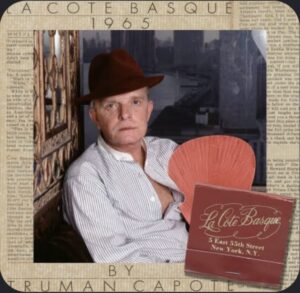
Fiction also noted such contempt for female diners, even the politer sort directed at women on a much higher social plateau. In his friendship-ending story ‘La Côte Basque, 1965’, a chapter of roman à clef ‘Answered Prayers’, Truman Capote has the restaurant’s real-life owner Henri Soulé, described as ‘distrait as ever, pink and glazed as a marzipan pig’, tut-tutting disapproval at Lady Ina Coolbirth (rumoured to be based on socialite Slim Keith) for rejecting his recommendation of a ‘very nice saddle of lamb’ for the time-consuming soufflé Fürstenberg and for dulling her taste buds with a bottle of Cristal.
A slight digression: while poorly written in part and overly reliant on ill-disguised gossip and general unpleasantness, ‘La Côte Basque, 1965’ is notable for being one of those rare works of fiction, like ‘A Christmas Carol’, ‘The Jungle’ and ‘Babette’s Feast’, to have an influence or even a direct impact on the world of food and drink. While Upton Sinclair’s 1906 novel exposed the poor conditions in American meatpacking stockyards, resulting in public outcry and the eventual passage of the Meat Inspection Act and the Pure Food and Drug Act, within a few decades of Capote’s 1975 takedown of the jet set, five of the six grand French dining establishments in New York, known collectively as ‘Les Six’ and very much part of his then turf, would close their doors, as tastes changed and people moved on. Old money high society’s cultural dominance also faded in the new world of celebrity and the ‘greed is good’ free market. (As Capote’s contemporary John Fairchild, the publisher of ‘Women’s Wear Daily’, remarked in the 1992 BBC documentary ‘The Look’: ‘There really is no society today: it’s just money.’) Additionally, the term ‘ladies who lunch’, often used to describe the fashionable socialites the writer knew oh-so well before being ostracised, would increasingly be seen as unfashionable, an outcome Capote hadn’t anticipated when he started drafting the story that led to his eventual downfall.
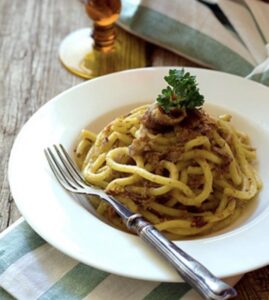
But not only writers were sensitive to such attitudes to women dining out. In fact, a London chef tried to right this wrong entirely. In the early eighties, Antony Worrall Thompson opened a restaurant in Beauchamp Place called Ménage à Trois, which became famous not only for its illustrious clientele, but for offering menus consisting entirely of starters and puddings. Speaking to ‘The Guardian’ in 2003, Worrall Thompson gave the reason for adopting such an approach: ‘I’d taken a lot of women out to dinner… I’d noticed that they always wanted two starters. I’d also noticed that if you saw two women eating together, they’d always be stuck by the loo or the kitchens, like second class citizens. They were getting a rough deal. So Ménage was a restaurant for women – and, of course, it helped a lot when the Princess of Wales started eating there.’ The restaurant even features in the fourth season of the Netflix series ‘The Crown’, as Lady Diana Spencer and Camilla Parker Bowles meet there in pre-royal wedding 1981 for a lunch of duck and truffle ravioli and orange and chocolate cream dessert.
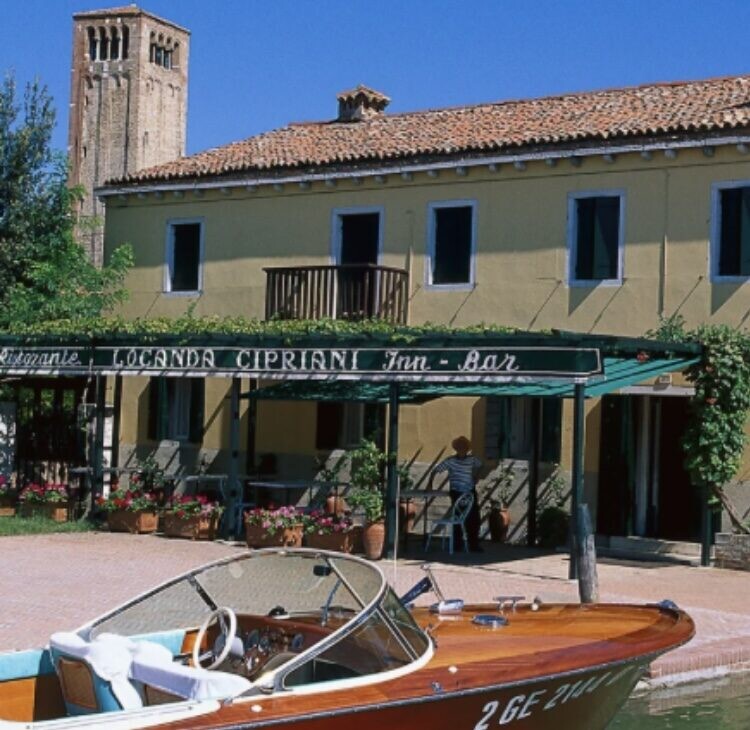
Restaurants were not only for entertainment and nourishment; they also often provided excellent copy for her journalism, as her commitments to various magazines and newspapers required the conjuring of new ideas to share with the public. Anyone purchasing a copy of ‘British Vogue’ in September 1958 was treated to a day-by-day, dish-by-dish account of her pilgrimage to Lamastre’s famous Hôtel du Midi in France’s Ardèche region. Two decades later, ‘The Herbal Review’ published an article entitled ‘Bruscandoli’, which memorably opened with an anecdote from a lunch shared with her sister and brother at Giuseppe Cipriani’s famous Locanda restaurant on the Venetian island of Torcello in 1969. After placing her order, David had noted a couple at another table ‘exclaiming with rapture over their food. They were a handsome and elegant pair. I wondered what was so special about the rice dish which was giving them such pleasure. They in turn noticed my curiosity. With beautiful Italian manners they passed some across to me, explaining that it was a risotto unique to Venice and unique to this particular season. It was made with a green vegetable called bruscandoli, or brucelando. Wild asparagus, so they explained. It was so good that I called the waiter and changed my order.’
That meal was a happy memory, though not all experiences were like that for her, as we know. But for all her sharpness, one does not read or hear of David ever being asked to leave early. (What chef, maître d’ or waiter would have dared!) The same cannot be said, however, for Fanny Cradock, who was equally known for being forthright with her opinions. Raymond Blanc, of Le Manoir aux Quat’Saisons fame, when interviewed in 2002 for the documentary ‘The Way We Cooked’, said that Cradock was one of three people he had thrown out of his restaurant. She had made demands, complained endlessly and even offered to show him how to run his business, which proved a step too far for the French chef, though he noted she had liked the food before her expulsion!
It is easy to cringe, tut-tut or look the other way at forthrightness, especially in Britain, but food and drink deserve high standards, whether prepared at home or eaten at establishments elsewhere, and for high standards to be maintained, a certain firmness is required. David knew that only too well, and was a hard taskmaster, not only on others but also herself. That is clear from her writing. Even when faced with competing deadlines and the demands of publishers and editors, she never gave way to exaggeration or falsehood to get the work done. Just as she prepared and cooked the dishes that appeared in print, she was also a scholar who believed in the almighty importance of chapter and verse. The same expectation was evident when dining out, whether at home or abroad. But she could be generous: when impressed, she let her pleasure be known, as the cooks of the Walnut Tree restaurant in Llanddewi Skirrid in Wales or San Francisco’s Zuni Café were to find.
However, given her response to the poor chef daring to serve her faux ‘wild’ mushrooms and thinking he could get away with it, we should hope such unfortunate incidents, when they did occur, were a rarity.
Alexander Reid – Guest Writer
Despite working for many years in various administrative roles, Alexander’s career ambition is to become a professional cook.
Although aware of Elizabeth David’s reputation, Alexander only started reading Elizabeth David’s books some six years ago and hasn’t thought of food the same way ever since. In addition to collecting her vegetarian and vegan recipes, as they are not identified as such in her books, Alexander is also conducting a review of Elizabeth David’s early journalism.
