



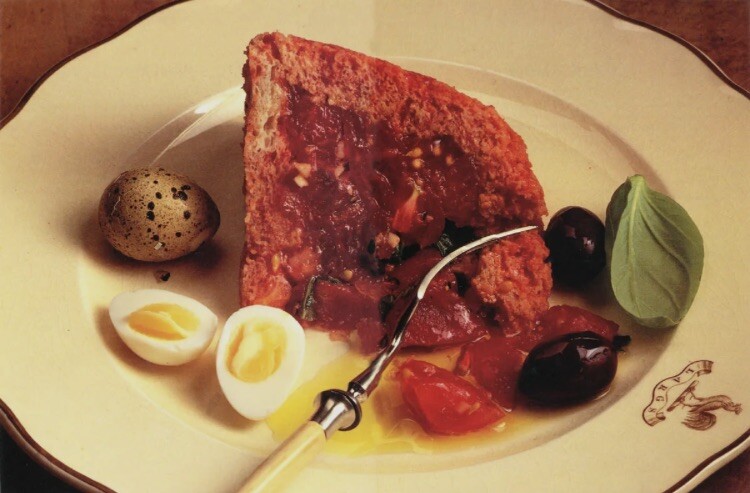
The Search For A Summer Pudding
Posted on Sat 27th June, 2026 by Alexander Reid – Guest Writer
The dish was tomato-based, the writer was almost certainly British, and I would know it when I read it. That was all I could remember!
Last year, there was for me a rare occurrence – in terms of cooking, that is: the need to cater for a vegetarian. Not only that, but a vegetarian ‘bordering’ on veganism and, just to make matters even more unique, a teetotal one at that!
Though with limited time or energy to spare, I nonetheless felt an acute desire to impress my guest. I had no inclination to learn a complicated dish, but knew I needed to do better than provide the standard cop-out of the broccoli quiche often recommended for the meat-eating cooks faced with such a dilemma.
In the planning, a recipe suddenly came to mind, though I could not for the life of me think of its name. Immediately, I turned to Elizabeth David. This was also a novel experience in itself, as it was the first time that I had actually ‘consulted’ her books for a recipe. The pleasure of Elizabeth David’s work lies in the reading and rereading, not in the mere flipping of pages as though consulting a manual for instructions. Such practical, almost transactional, activity didn’t seem right, somehow.
A Book of Mediterranean Food, alas, failed to produce the recipe; the same for French Country Cooking. I crossed my fingers with Summer Cooking, but that also bore no fruit. Instinct told me I was unlikely to find it in her other books (one which proved right), so I left it at that and looked elsewhere.
It was a day or two later that I secured my prize. Luckily, I have long noted the titles of books I have consumed and the years read, a wonderful piece of advice received at an early age that I would recommend to anyone. Not only can it be useful (as it proved to be in this case), but knowing what we read and when reveals much about ourselves and looking back on past reading lists can indeed be as intriguing as old bank statements.
The recipe was the Tomato Summer Pudding, and its creator was a rather unlikely candidate: Jennifer Paterson, the chain-smoking, vegetarian-loathing cook who achieved international fame with the television series Two Fat Ladies. Paterson, who was a great admirer of Elizabeth David’s work, had created the recipe for the Spectator, for which the latter had earlier contributed some of her finest journalism with articles such as ‘Fast and Fresh’ and ‘Para Navidad’. It was in Paterson’s Feast Days, a collection of her recipes (or ‘receipts’, as she always referred to them), published in 1990, that I had come across it. (She had, it turns out, also prepared the dish in the first series of her programme.)
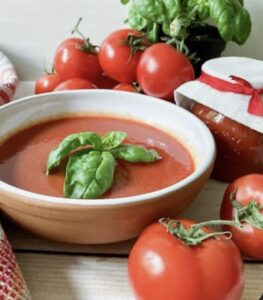
The Tomato Summer Pudding is a magnificent blend of English practicality and Italian flair. It is also a blessing for those who make it by being both simple and economical. Even in this time of rising food prices, as long as you already have a bottle of olive oil in the cupboard and depending on where you source the ingredients from, it can certainly at the time of writing be made for under a ‘tenner’ and with change to spare. It also benefits from being so filling that it, depending on the size of the bowl used, can contribute to several meals, and the taste of it actually improves with a brief reheating.
The recipe, adapted from Paterson’s, is as follows:
Soak decrusted pieces of stale bread in tomato passata and line a bowl until covered. When ready, pour in a mixture of roughly chopped sugared tomatoes, garlic, basil leaves and Worcestershire sauce, topped with salt and pepper and laced with lemon juice. Once full, seal with a generous drizzle of olive oil and enclose the pudding with the rest of the soaked bread and press down with a plate before leaving it to rest for ten to twelve hours in the fridge. Once freed from the bowl, lay the pudding on a fresh plate (I placed mine on a mountain of the chopped tomatoes that didn’t make the mix) and add your garnishes. (Paterson recommends serving with boiled eggs and sour cream, but being pressed for time, sliced lemons and tomatoes along with a sprinkling of herbs did just as well, frankly.)
It is a wonderful moment when a first-time experiment succeeds, and it was in a blaze of pride that I brought my creation out for eating. But pride does indeed come before a fall, and it was in the happy reciting of the ingredients that I remembered the inclusion of the fish-based Worcestershire sauce, thus rendering my triumph null and void as far as my guest was concerned.
However, nothing is wasted. Returning to my books a day later, many of them heavily dog-eared and bookmarked as a result of my search, I realised how many wonderful recipes suitable or adaptable for vegans and vegetarians there are to be found in David’s books and articles, and yet, unless a reader is prepared to go to the efforts I had to find that unknown pudding, you would not know they were there. They hide among the pages. They are not identified as vegetarian or vegan in the recipes themselves, nor are they labelled as such in the index, making the finding of a suitable recipe an even longer process. (David, as indeed was Paterson, is far from being alone in this. Such omissions are common in food writing and publishing and very much in evidence even today.)
Therefore, in anticipation of future lunches and dinners requiring vegetarian or vegan fare (my ill-fed guest was most forgiving on this occasion), I have spent several pleasant hours noting many of such dishes from David’s first, second and fourth book, which I hope to share with you in the near future on Elizabeth David Matters.

Alexander Reid – Guest Writer
Despite working for many years in various administrative roles, Alexander’s career ambition is to become a professional cook.
Although aware of Elizabeth David’s reputation, Alexander only started reading Elizabeth David’s books some six years ago and hasn’t thought of food the same way ever since. In addition to collecting her vegetarian and vegan recipes, as they are not identified as such in her books, Alexander is also conducting a review of Elizabeth David’s early journalism.
